An Electromagnetic Tether for Satellite Deorbitation: Deployable Composites for Space Debris Mitigation
Published in 2025.
The Space Debris Problem
More than 27,000 pieces of orbital debris are currently tracked by space agencies — and millions more are too small to track but large enough to destroy a satellite on impact. As the number of launches increases with commercial space activity, the risk of cascading collision events (Kessler syndrome) grows. One of the most tractable solutions for small satellite operators is to design satellites that deorbit themselves at end-of-life, rather than remaining in orbit indefinitely.
For small satellites in low Earth orbit, electrodynamic tethers offer a particularly attractive approach among passive deorbitation mechanisms. A long, thin conductive tether generates electromagnetic drag when current flows through it in Earth’s magnetic field — requiring no propellant and minimal mass.
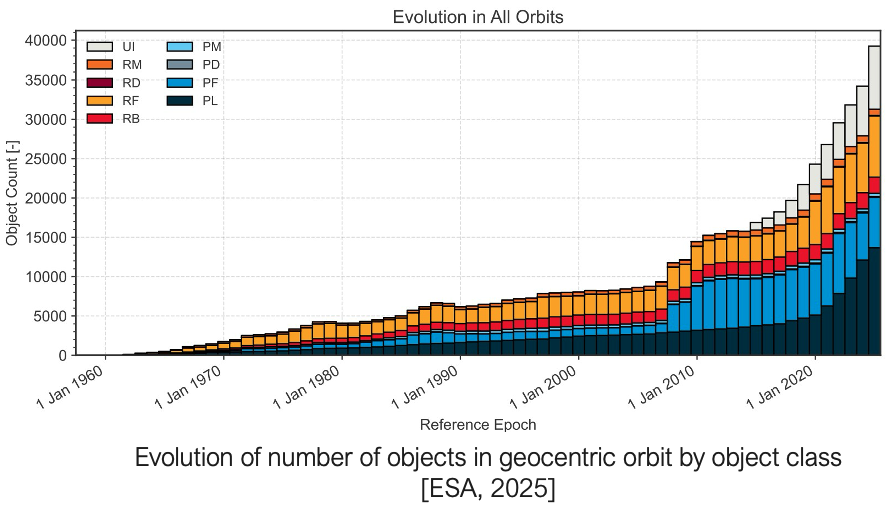
Kessler syndrome visualization: as satellites collide, they fragment into more debris, creating a cascade effect that could render certain orbital regions unusable for generations.
The Composite Deployment Challenge
The key engineering challenge is deploying and maintaining a long, conductive tether in the constrained mass and volume envelope of a small satellite. A meter-scale composite mechanism must be compact in stowed configuration, then reliably deploy and stabilize a thin conductive tether in orbit. This is fundamentally a materials and structures problem: the deployment mechanism must be
- Ultra-lightweight (mass budget is critical for small satellites)
- Highly packable (must deploy from a volume-limited container)
- Structurally stable during deployment and in the orbital environment
- Reliable after long periods in stowed configuration
Our Solution
This work presents a deployable composite mechanism that stabilizes and deploys an electrodynamic tether. The system combines elastic composite structures (for spring-loaded packaging and reliable deployment) with a conductive tether (typically a thin metal wire or mesh). We analyze the trade-offs between tether length, material choice (aluminum, copper), deployment mechanism complexity, and achieved deorbiting time for typical small satellite missions.
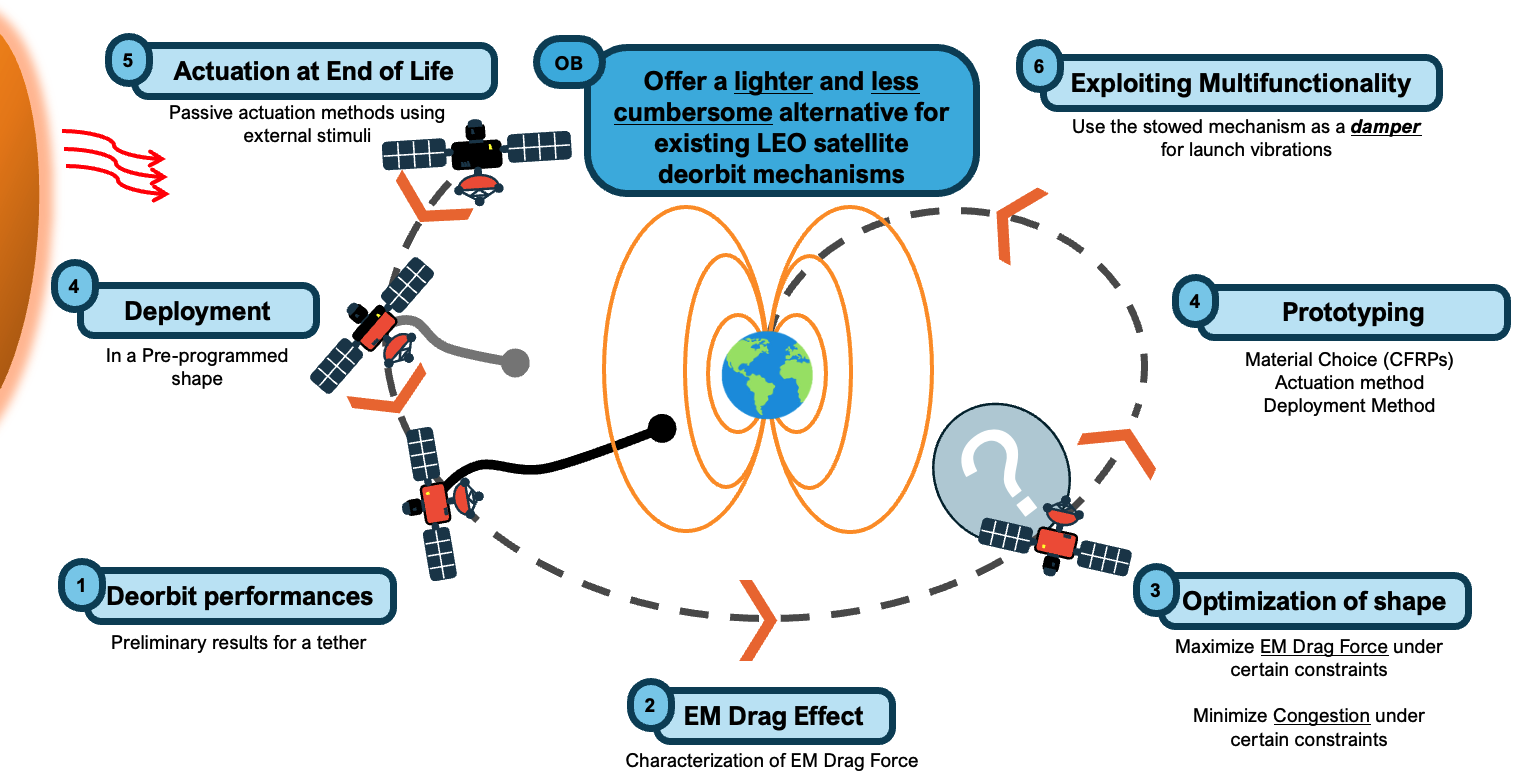
Electrodynamic tether deployment concept: the composite mechanism deploys and stabilizes a conductive tether that generates electromagnetic drag via interaction with Earth's magnetic field (F = I × L × B).
The results demonstrate that deployable composite mechanisms enable practical electrodynamic tether systems for small satellite deorbitation, and that polymer composite design and manufacturing expertise is essential for meeting the mass and reliability constraints of space sustainability infrastructure.
About This Work
This research was conducted by Dorian Stefan Dumitru, Ilyass Tabiai, and David Mélançon. It represents a collaborative effort at the intersection of composite materials engineering, mechanical design, and space sustainability.
This work was made possible with the support of the Canadian Space Agency (CSA) and the Consortium for Research and Innovation in Aerospace in Québec (CREPEC), which provided financial support for this research initiative.
Leave a comment