My Publication Record, Reconstructed From My Inbox
A CV reports outcomes: a title, a journal, a year. It does not record the rejections, the revisions, the months in review, or the volume of correspondence behind each line. That record exists, but it lives in the email inbox.
So I reconstructed it. A language-model agent swept roughly 60,000 messages and indexed more than 1,000 date-stamped emails spanning 66 works: journal papers, conference papers, theses, and drafts. The method was to enumerate submissions by querying the generic phrases every editorial system sends to every author (for example “Confirm co-authorship of submission to”) across all mail folders. From that corpus I isolated 23 journal submissions, which account for roughly 600 of those emails, and tied every submission, decision, revision, rejection, and acceptance to a specific message.
This is a single case study, my own record, not a survey. Every number below is measured from my own mailbox rather than estimated.
The flow of publication
The whole record fits in one diagram: every paper enters on the left, each rejection sends it to another journal, and the right shows where it is now.
By final status, most submissions succeed: 17 of 23 are published or in press, and 6 are still under review. Through the process, several are contested first. 8 of 23 papers were rejected or shopped to another journal before they landed, across 13 outright rejections at 7 journals, several of them desk rejections issued without any review. In some cases, as we will see, these rejections were simply wrong, and only author persistence through the reviewer lottery, until a referee with the right expertise was finally drawn, changed the outcome.
Six of my papers received at least one formal rejection. Five of those six are now published; one is still under review. The most extreme case, a paper on anisotropy in 3D-printed structures, took six submissions across three journals (rejected twice at Additive Manufacturing and three times at Materials & Design) before acceptance at the Journal of Manufacturing Processes. That case is detailed below, because it exposes the most fundamental weakness of peer-reviewed publishing.
Rejection is the default path
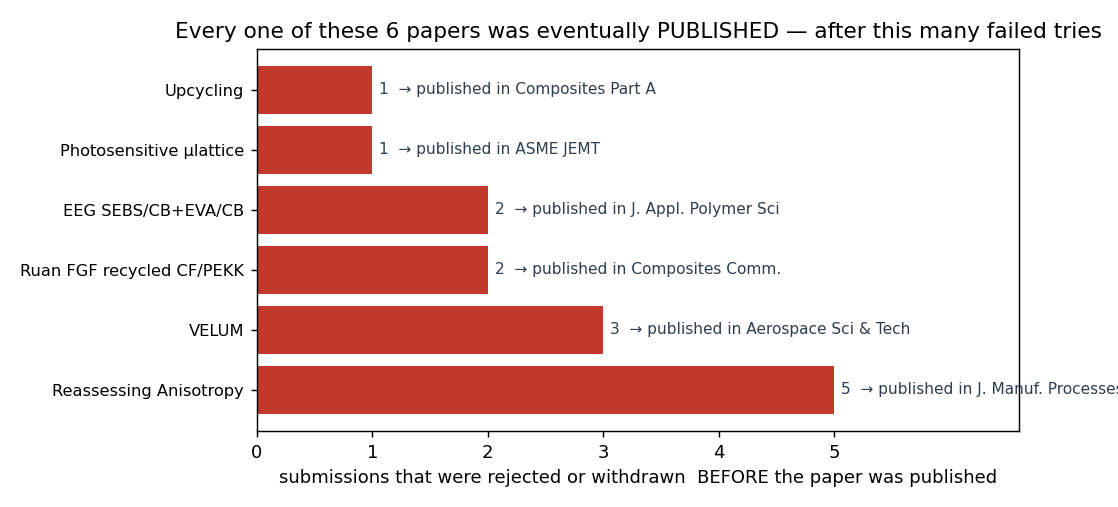
A reported acceptance rate, the number that ends up on a CV, is what remains after this persistence. It does not measure the persistence. Measuring that cost is the point of this post. The work eventually landed across seven publishers.
Observation 1. With enough venues, almost any sound paper is eventually published. Five of the six papers that were formally rejected are now in print, several of them essentially unchanged from the version a previous journal rejected. An acceptance rate therefore measures what survived the process, not a quality filter.
The appeal that was not there
Three times in the record we judged a decision to be incorrect and contacted the editor to make our case, with reasons. The reasons were specific:
- a point-by-point rebuttal arguing the reviewers had misread the method;
- a direct statement that the reviewers had not read the paper;
- an offer to revise and clarify the contested section.
No editor ever replied. Not a reversal, not a defence of the decision, not an acknowledgement. Let me write it a second time: no editor ever replied. Two appeals were answered only by a publisher support agent who restated the rejection or said it had been “forwarded to the handling editor,” after which nothing followed; the third met total silence.
What makes this sharper is who raised the appeals. In almost every case the request came from the PhD or MSc student who had written the paper and felt, with reason, that the reviews were deeply unfair. When the students asked their supervisors (which I am part of) to contact the editor, we always told them the same thing: you can try, but the probability of a reply is extremely low. That answer is itself the finding. The editor’s role, at the point of appeal, is mechanical and performative; the editor does not intervene to correct or challenge an inaccurate review. And we all know that.
The observation is structural, not personal. In this process there is effectively no appeal. A decision is final, independently of the quality or validity of the reviews it is based on, and the only available response is to resubmit elsewhere.
Observation 2. There is no functioning appeal. Across three reasoned appeals, none drew a substantive reply from an editor. The only effective response to a wrong decision is to start over at another journal. For an early-career researcher, this is worth knowing before it happens.
Time in review
Median time to a first decision was 49.5 days; median time to acceptance was 130 days; the slowest single paper spent 406 days in review. Across the accepted papers, this sums to roughly 7.7 person-years of cumulative waiting.
Measured from the first submission of a finished result to its eventual publication, the gap is larger still.
The published papers spent a combined 13.7 person-years unpublished and therefore uncitable, with a further 6.5 person-years still in review at the time of writing. Multiply-rejected papers dominate this total, because each rejection restarts the clock: a new cover letter, a new template, a different set of submission guidelines, the journal’s editorial-manager system, the editor’s first check, the wait for the reviewer draw, and only then a decision.
Observation 3. A finished result is invisible for years. The time a completed result spends unpublished, and therefore uncitable, is measured in person-years, and each rejection adds to it. The cost is not just the researcher’s wait; it is the delay before the rest of the field can build on the result.
The administrative load
The 23 journal submissions account for roughly 520 emails, about 23 per submission, across 34 separate revision rounds: co-authorship confirmations, reminders, proof corrections, rights forms, and revision letters. The journal-paper count is about 520 rather than the full sweep of more than 1,000 indexed emails because the remainder of the corpus belongs to conference papers, theses, and drafts.
This correspondence is unpaid administrative work, carried mostly by the corresponding author and the students, and separate from the research itself. It is also unevenly distributed: the bulk of the volume is plain correspondence and reminders, not scientific content, and it scales with the number of submission attempts rather than with the quality or difficulty of the work. A multiply-rejected paper generates several full administrative cycles for a single result.
Observation 4. Shepherding a paper through submission is a second, unpaid job. Each submission cost about 23 administrative emails, and the load falls on students and the corresponding author. It grows with the number of attempts, so a contested paper is taxed twice: once in waiting, once in paperwork.
Reviewer quality
Each review legible in the decision letters was scored from 1 to 5 on five axes: civility, constructiveness, relevancy, substance, and clarity. The scoring was done by a language model reading the verbatim reviewer text, with tone and rudeness flags assigned the same way. 77 reviews were legible enough to read; 57 carried a complete five-axis score. This is an automated, single-rater pass rather than a validated instrument, so the scores are indicative, not definitive.
The scores cluster high, and that clustering is itself the result. Reviews were consistently polite (civility 4.8) and on topic (relevancy 4.5); the only axis that drops is substance (3.5). In other words, reviews reliably perform the form of review and vary mostly in whether they engage with the work.
The civility-to-substance correlation is r = 0.23, computed across the 57 fully scored reviews, so how courteous a review is says almost nothing about how deeply it engages with the work. Only 9 of the 57 scored reviews carried a rudeness or dismissiveness flag; the more common limitation was a polite review with little technical content. Whether a paper received a deep read depended largely on reaching one of the few expert reviewers.
Observation 5. Civility is not depth. Reviews were uniformly courteous but only moderate in substance, and the two are nearly independent (r = 0.23). The dominant failure mode is not hostility; it is a polite review that does not engage. Whether a paper is read deeply depends on drawing one of the few expert reviewers.
Case study: the paper three editors would not review
One manuscript shows the whole machine in miniature. The science was a clean correction. 3D-printed plastic parts are weak in the build direction, and the field’s default explanation was poor molecular bonding between layers. Maryam Shokrollahi’s experiment tested a rival explanation: that the weakness is geometric, the ribbed surface left by the printing process acting as a field of stress concentrators. She machined the ribbing off and re-tested. The interlayer bond turned out to be essentially as strong as bulk material. The weakness was geometry. That is a field-level correction, not an incremental result.
It was rejected five times in roughly eight months:
- Additive Manufacturing, reviewed: “a modest exploration that does not meet our requirement for significant new transferable knowledge.”
- Materials & Design, desk reject: “only a technical report.”
- Materials & Design, reviewed: “removing these surface irregularities increases the strength, which seems quite predictable, not sufficient to justify publication.”
- Additive Manufacturing, desk reject: conclusions judged “too premature.”
- Materials & Design, desk reject: comments-to-authors field left blank.
Three of those five rejections never reached a single reviewer. An editor screened the paper out, once with no written comment at all. The manuscript did not change.
We then transferred it to the Journal of Manufacturing Processes. The next day it was assigned and sent out for review, and it reached a referee, Reviewer #5, who knew finite-element modelling and material-extrusion printing. That reviewer wrote:
“This is an important paper that is well designed. It finds conclusive evidence that is critical for the field to understand and appreciate related to interlayer bonding.”
“Figure 6 is really compelling, directly contrasting the widespread belief that interlayer weakness is due to poor intermolecular bonding.”
“I anticipate a risk of reviewers with less directly related experience overlooking this work as just another paper on mechanical testing of MEAM parts.”
The expert predicted the exact failure the paper had already suffered five times. The same reviewer urged the authors to drop the timid framing and make the bold claim, which became the new title, “Reassessing Anisotropy in 3D Printed Structures.” One revision round later it was accepted and published.
Observation 6. The bottleneck is the editor, not the science. The same unchanged manuscript was screened out three times without review and dismissed as “predictable” twice, then called “critical for the field” once a qualified reviewer read it. If the transfer had failed, or if a different referee had been drawn, a correct and useful result would simply have ceased to exist.
Who produces the output
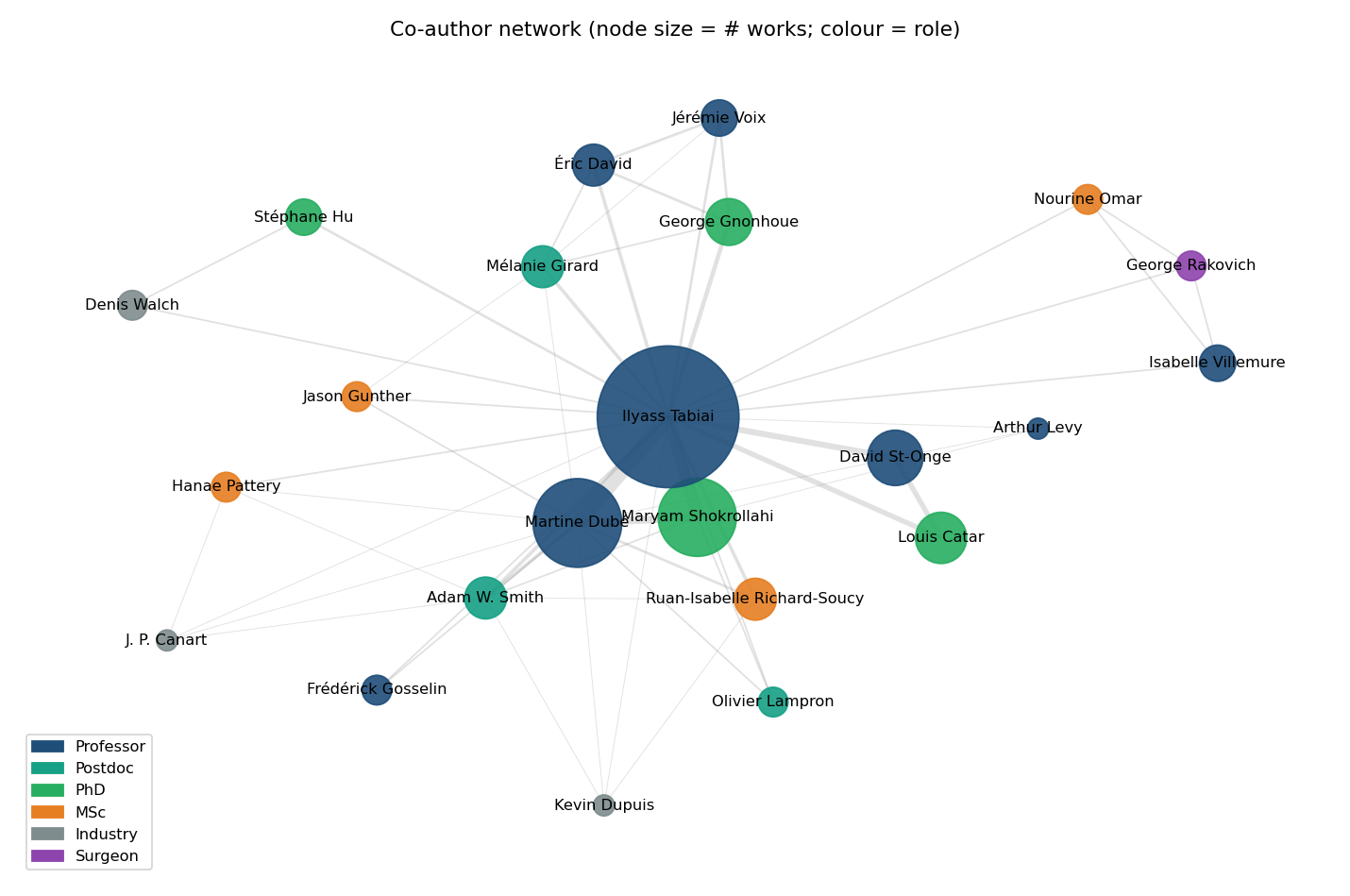
The reconstructed network contains about 60 people and is driven by students.
Time from a student’s first submission to their first publication ranged from 117 to 849 days. Within one group, doing comparable work, that spread is set largely by which journals and reviewers a paper happens to draw, not by the quality of the work.
These numbers collide with the timelines that govern academic careers. A thesis-based engineering master’s runs about two years and a doctorate four to five, and many programs expect a published or accepted paper before the defence. An 849-day path from first submission to publication is longer than an entire master’s degree, and it is not under the student’s control. A student can finish the science and still be blocked from graduating by a reviewer queue. The same clock runs against the supervisor: an early-career professor is typically reviewed for contract renewal at roughly two-year intervals and for tenure a few years after that, and those reviews count published output. A two-year publication delay means work completed in year one may not yet be in print at the first renewal. The delay is therefore not only an inconvenience; it is a structural risk to both the student’s graduation and the supervisor’s career, imposed by a process neither of them controls.
Observation 7. Publication delay is a career risk, not just a wait. A single paper’s 849-day path exceeds an entire master’s degree and overlaps the renewal and tenure clocks that decide careers. Time lost in review is borne by the people with the least slack to absorb it.
The same machine, at planetary scale
The pattern in one inbox is the pattern of the system. Peer review is one of the largest pools of unpaid skilled labour on earth: a 2021 study estimated reviewers spent on the order of 130 million hours on peer review in 2020, with the donated time valued at over $1.5 billion for United States reviewers alone, almost none of it paid or credited.1 That labour is getting harder to recruit. At a set of journals, the share of review invitations that produced a completed review fell from 56% in 2003 to 37% in 2015.2
The certification the system sells is also noisier than its reputation. When a major computer-science conference had two independent committees review the same papers, about half of the papers accepted by one committee were rejected by the other (49.5% in 2014, 50.6% when the experiment was repeated in 2021).3 Acceptance is part signal and part coin flip, which is the system-scale version of the reviewer lottery in my own record.
Delays are the norm and vary by field, from roughly 9 months submission-to-publication in chemistry to about 18 months in business and economics.4 And the money runs one way: the scientific-publishing arm of RELX, Elsevier’s parent, reports an operating margin around 38%, higher than Apple, Google, or Amazon,5 while a single open-access article in Nature now lists at roughly $12,850.6 Public funds pay for the research, academics referee it for free, and the same community pays again to publish or to read it.
The absence of appeal is structural too. Under the published policies of the major publishers, an appeal is returned to the editor who issued the decision, the appeal decision is declared final, and a disagreement over novelty or significance is often not even valid grounds.7 The external body that might intervene, COPE, states that it reviews procedural issues but does not intervene on editorial decisions.8 The silence I met was not an exception; it is the design.
What the record shows
For an early-career researcher, the measured points from this record:
- Rejection is the normal case, not a verdict. Most of these papers were rejected somewhere first and published anyway, often unchanged.
- There is no real appeal. If a decision is wrong, the working response is to resubmit elsewhere, not to argue.
- Time in review is measured in months per paper and person-years in aggregate, and it collides directly with graduation and tenure timelines. Plan funding and student timelines around it, and post a preprint so the result is public and citable on day one.
- The administrative load is a part-time job in its own right, and it grows with every rejection.
- Reviewer depth varies widely and is weakly related to tone. A polite review is not necessarily a deep one; judge a review by its substance, and remember that drawing an expert is partly luck.
The inbox version of a publication record is less tidy than the CV, but it is the one that reflects the actual cost of the work.
-
Aczel, Szaszi & Holcombe (2021), “A billion-dollar donation: estimating the cost of researchers’ time spent on peer review,” Research Integrity and Peer Review 6:14. ↩
-
Fox, Albert & Vines (2017), “Recruitment of reviewers is becoming harder at some journals,” Research Integrity and Peer Review 2:3. ↩
-
Cortes & Lawrence (2021), “Inconsistency in Conference Peer Review: Revisiting the 2014 NeurIPS Experiment,” arXiv:2109.09774. ↩
-
Björk & Solomon (2013), “The publishing delay in scholarly peer-reviewed journals,” Journal of Informetrics 7(4). ↩
-
Buranyi (2017), “Is the staggeringly profitable business of scientific publishing bad for science?” The Guardian; RELX annual results (~38% adjusted operating margin). ↩
-
Nature Portfolio article-processing-charge schedule, 2024–25. ↩
-
Editorial appeals policies of Elsevier, Springer Nature, Wiley, and Taylor & Francis: appeals are handled by the editor who made the decision, the appeal decision is final, and disagreements over novelty or significance are generally not valid grounds. ↩
-
Committee on Publication Ethics (COPE), Complaints and Appeals guidance: COPE reviews procedural issues but does not intervene on editorial decisions. ↩
Leave a comment