VELUM: Ultra-Lightweight Composite Membranes for Minimal-Leakage Aerial Vehicles
Published in Aerospace Science and Technology (2026).
A New Membrane Architecture for the Next Generation of Airships
Airships and aerostats are experiencing a renaissance. Driven by the need for persistent, energy-efficient aerial platforms, from surveillance to cargo transport, interest in lighter-than-air vehicles has grown significantly in recent year. At the heart of any aerostat is its envelope membrane: the structure that contains the lifting gas, bears the aerodynamic loads, and must do all of this at the lowest possible mass. The membrane must also reduce gas losses as much as possible. Gases used to lift airships are composed of very small molecules (helium or hydrogen) that tend to gradually escape through any membrane, so being as impermeable as possible is a critical property of any membrane.
Our latest paper introduces VELUM: a novel composite membrane architecture specifically engineered for minimal gas leakage while maintaining ultra-low areal mass. This work complements the lab’s ongoing research on lightweight rigid structures for indoor aerostats (see the 3D Printed Aerostats project), now extending to the flexible envelope itself.
The Problem: Leakage vs. Mass Trade-off
Helium and hydrogen, the gases used in lighter-than-air vehicles, permeate slowly through any membrane. For small indoor aerostats, even slow permeation means frequent refills and limited mission duration. The conventional solution is to increase membrane thickness or add barrier coatings, but both approaches add mass, directly reducing the useful payload.
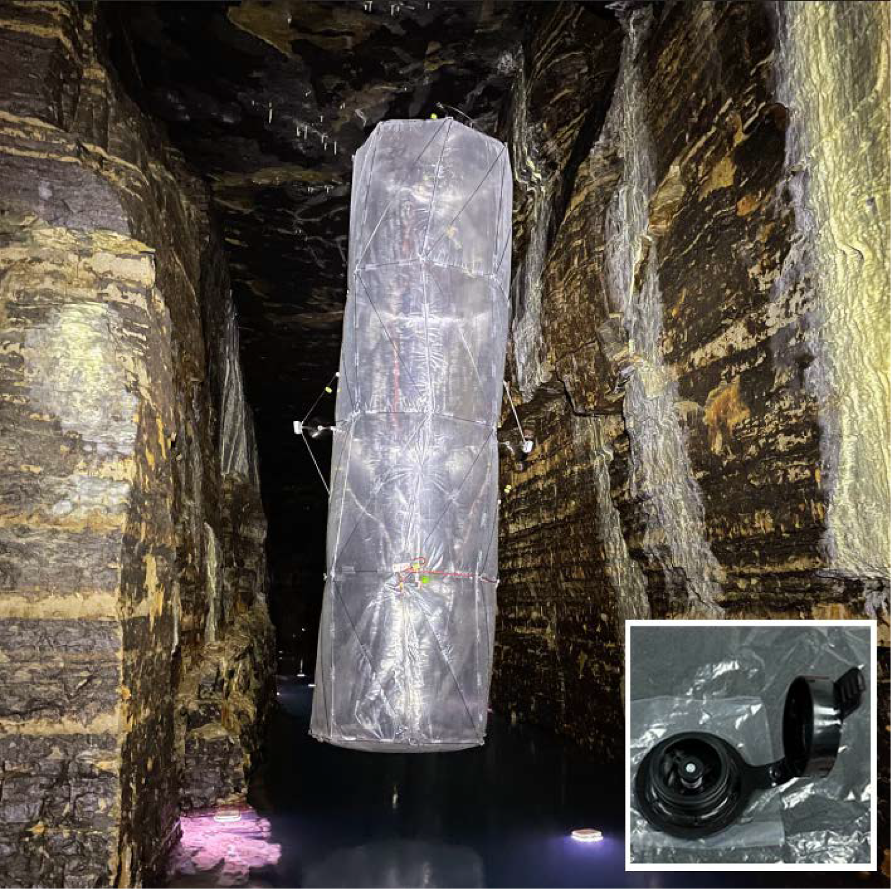
Figure 15a: LDPE VELUM envelope during mission deployment in a cave environment, with inset showing the one-way valve assembly.
The VELUM architecture addresses this leakage-mass trade-off through a structured composite approach: combining carefully selected barrier films with structural textile reinforcements in a geometry optimized for permeation resistance without thickness penalty.
The membrane we designed is made from LDPE, a plastic that is lightweight and durable, and combines it with a special coating that significantly reinforces its impermeability while retaining its mechanical properties and beneficial properties. More details about its properties and composition are available in the publication and the Canadian patent that was produced out of this work.
Key Contributions
- Novel membrane architecture that decouples gas barrier performance from structural stiffness requirements
- Experimental characterization of helium permeation, tensile properties, and areal density for the proposed system
- Comparison with state-of-the-art commercial aerostat envelope materials
- Design guidelines for membrane selection and layup in ultra-lightweight airship applications
What This Means for Airship Design
The VELUM results demonstrate that it is possible to achieve competitive gas barrier performance at lower areal mass compared to commercial alternatives. This creates new design space for mission planners: longer autonomous missions, larger payload fractions, or simply smaller and more agile vehicles for the same mission profile.
About This Work
This research is a direct collaboration between ilylabs and Prof. David St-Onge at ÉTS. The VELUM membrane architecture and all experimental characterization are the primary work of Afsaneh Kheirani, who completed her MSc thesis on this project in the lab. Her contributions to lightweight composite design and permeation science have opened new pathways for next-generation aerostat systems.
Leave a comment