Printing on the Moon: LDPE–Lunar Regolith Composites for Space Manufacturing
Published in Acta Astronautica (2025).
Building Structures on the Moon — Without Shipping Everything from Earth
One of the most significant constraints on future space exploration is the cost of launch mass. Every kilogram sent to the Moon costs thousands of dollars and requires months of planning. For a permanent lunar presence — a base, a research station, or a manufacturing hub — bringing all structural materials from Earth is not a sustainable model.
In-Situ Resource Utilization (ISRU) offers an alternative: use what is already there. The Moon’s surface is covered in regolith — a fine, mineral-rich dust that is the byproduct of billions of years of meteorite impacts. If we can combine this regolith with a small amount of binder material brought from Earth (or eventually produced on-site), we could 3D print structural parts on the Moon using locally sourced feedstock.
Our Approach: LDPE as the Binder Matrix
This work investigates Low-Density Polyethylene (LDPE) as the polymer matrix for lunar regolith composites. LDPE is thermally processable, relatively lightweight, and compatible with standard fused deposition manufacturing processes. By loading it with increasing fractions of lunar regolith simulant, we characterize how the composite’s rheology, printability, and mechanical properties evolve.
Key Findings
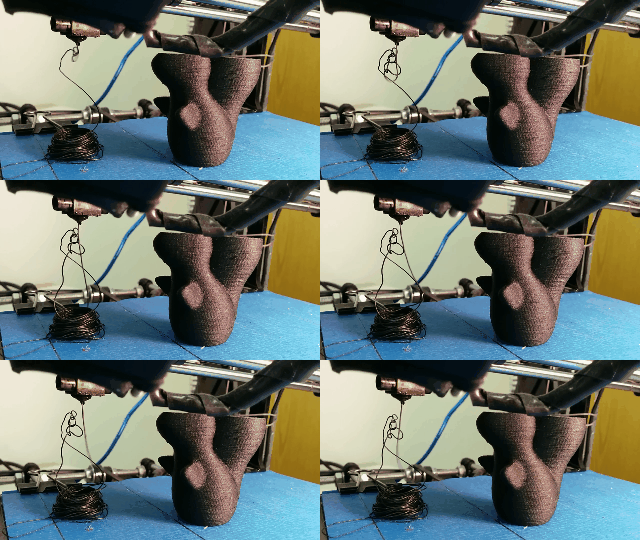
- Printability window: LDPE–regolith composites remain processable via FDM up to moderate regolith fractions; beyond a critical loading, filament brittleness and nozzle clogging become limiting factors
- Mechanical properties: Tensile strength and stiffness evolve non-monotonically with filler content — small additions can improve properties, while excess loading degrades the matrix-filler interface
- Surface morphology and porosity: Regolith particles affect layer adhesion and introduce controlled porosity, with implications for thermal insulation in lunar structures
- Pathway to ISRU: The results establish feasibility and provide design guidelines for a first-generation lunar additive manufacturing system
Why This Matters
This work is a first step toward closing the loop on off-world manufacturing. Future missions to the Moon — and eventually Mars — will depend on our ability to fabricate and repair structural components on-site. Understanding how regolith-filled polymers behave under print conditions is foundational knowledge for that future.
Leave a comment